An enterprise dashboard can show a 12% increase in revenue, a decline in customer churn, or an improvement in operational efficiency. It can present the numbers in real time, highlight emerging trends, and give executives a clear view of business performance.
The gap between showing a number and defending a decision
But what happens when an auditor, regulator, board member, or risk committee asks a more difficult question?
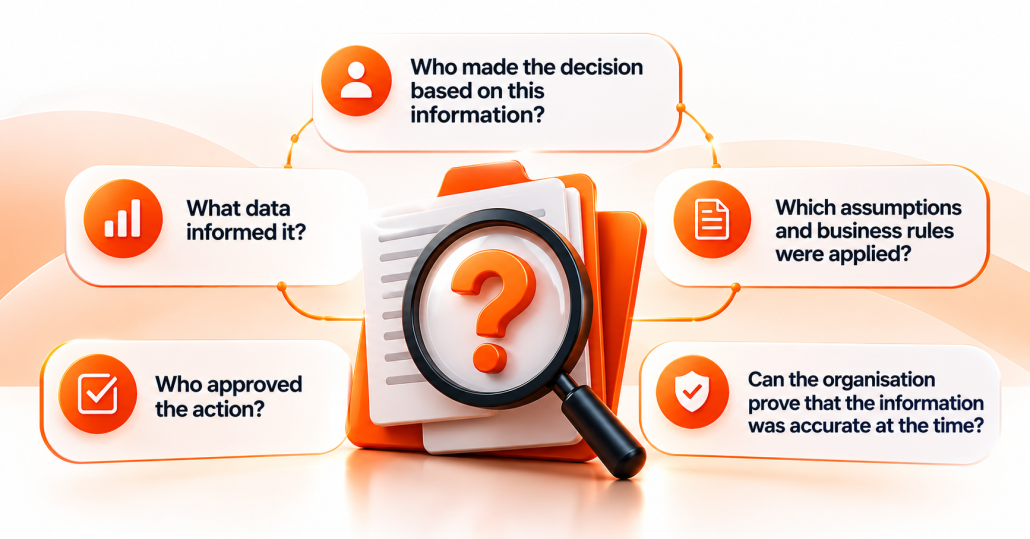
For many enterprises, answering these questions is considerably harder than producing the dashboard itself.
The figures may be correct. The visualisations may be impressive. The underlying data infrastructure may be sophisticated. Yet the organisation may still struggle to reconstruct the reasoning behind a significant business decision made six months earlier.
This is the gap between reporting and accountability.
Modern business intelligence (BI) tools have made enterprise performance easier to observe. However, visibility alone does not establish how a decision was reached, whether the appropriate controls were followed, or whether the organisation can defend its actions under scrutiny.
As enterprises make increasingly consequential decisions using interconnected data systems, automated workflows, predictive models, and artificial intelligence, this distinction becomes more important.
The challenge is no longer simply knowing what happened. It is being able to demonstrate why a particular action was justified, using the evidence, rules, approvals, and business context that existed when the decision was made.
That is where traditional dashboards reach their limits.
1. Dashboards Were Built to Inform, Not to Defend
Business intelligence has transformed how organisations monitor performance. Executives no longer need to wait for monthly reports to understand revenue movements, operational bottlenecks, customer behaviour, or financial exposure. Data can be consolidated from multiple systems and presented through interactive dashboards that make complex information easier to interpret.
This is valuable. In many organisations, it is essential.
However, the ability to observe a business outcome is not the same as the ability to reconstruct the decision that produced it.
Most BI environments are designed to aggregate data, identify patterns, monitor key performance indicators (KPIs), and communicate insights. Their purpose is to help people understand what is happening so they can respond appropriately.
An audit introduces a different requirement.
It asks the organisation to establish what information was available at a specific point in time, how that information was processed, which policies or business rules applied, who exercised decision-making authority, and whether the resulting action followed the required governance process.
These are related but distinct capabilities.
A dashboard might show that a bank’s credit default rate has declined. It does not necessarily establish whether a change in lending policy contributed to the improvement, whether exceptions were approved correctly, or whether the underlying model and customer data were appropriate for the decisions made.
Similarly, a procurement dashboard might show reduced spending. It may not reveal whether the savings came from legitimate supplier negotiations, deferred maintenance, changes in reporting classifications, or the exclusion of certain costs from the analysis.
The headline metric describes an outcome. It does not, by itself, explain the process behind it.
The problem with simplifying complexity
Dashboards are effective partly because they simplify. They transform large volumes of operational information into a manageable set of indicators, charts, and trends.
But simplification can also obscure the details needed to defend a decision.
A metric might depend on several upstream systems, data transformations, business definitions, manual adjustments, and filters. Some of these rules may exist in code. Others may be documented in spreadsheets, approval emails, policy documents, or the knowledge of individual employees.
The dashboard presents the final number, while the reasoning and control mechanisms behind that number remain distributed across the organisation.
When the reporting process changes, the dashboard may update accordingly. A filter may be modified, a data pipeline corrected, or a business definition revised. The current view may become more accurate, but the historical context of an earlier decision may no longer be readily accessible.
This is not necessarily a failure of the dashboard. It is a mismatch between the purpose of reporting tools and the requirements of decision accountability.
The central issue is not whether an enterprise can produce a number. It is whether it can reconstruct and defend the decision made using that number.
2. Where Enterprise Dashboards Break Under Scrutiny
The gap between reporting and auditability becomes clearer when examined through four common failure points.
2.1 Metrics without complete data lineage
Consider a financial services organisation that uses a dashboard to monitor loan portfolio performance. The dashboard reports that non-performing loans have fallen over the past quarter.
An auditor wants to understand how the figure was calculated and whether the improvement accurately reflects the underlying portfolio.
The investigation requires more than the displayed percentage. It may involve tracing records to the originating banking systems, reviewing data extraction and transformation processes, understanding how delinquent accounts were classified, and determining whether any exclusions or adjustments were applied.
If the organisation cannot reliably connect the reported metric to its source data and transformation logic, the figure becomes difficult to verify.
This is the problem of incomplete data lineage.
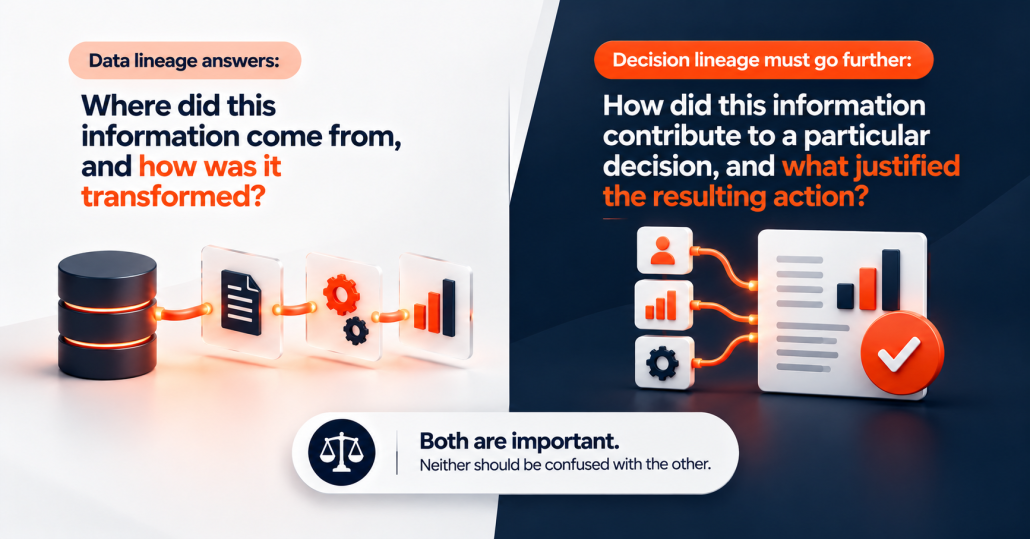
Enterprise data lineage describes how data moves from its source through ingestion, transformation, processing, and eventual use. It helps organisations understand where information originated, how it changed, and which downstream reports or systems depend on it.
However, data lineage alone does not establish why a business decision was made using that information.
An organisation might be able to trace a revenue figure to its source systems but still be unable to explain why management used that figure to approve an acquisition, change pricing, or allocate additional capital.
2.2 The same metric means different things to different departments
A second problem emerges when different teams interpret the same business metric differently.
Take customer churn.
The product team may define churn as the cancellation of an active subscription. Finance may classify churn based on recurring revenue lost during a reporting period. Sales may exclude customers who have temporarily suspended their accounts but remain commercially recoverable.
Each definition may be appropriate for its intended use.
The problem arises when all three departments report a metric called “customer churn” without a shared definition or clearly documented differences.
An executive reviewing a consolidated dashboard may assume that the numbers are comparable. A board presentation may then use the figures to justify a pricing change, a customer retention investment, or a revised growth forecast.
If the definitions cannot be reconciled, the decision rests on an inconsistent understanding of performance.
This is a semantic governance problem.
It extends beyond churn to metrics such as customer lifetime value, profitability, cost of acquisition, operational risk, and return on investment.
Without agreed definitions, ownership, and version-controlled business logic, organisations can produce technically valid reports that communicate conflicting business realities.
An audit can expose this problem, but its implications are broader. Leaders may be making strategic decisions using figures that appear consistent while representing different underlying assumptions.
The solution is not simply to standardise every metric regardless of context. It is to make definitions explicit, establish ownership, document approved variations, and preserve the logic used for consequential decisions.
2.3 Silent changes destroy historical context
Enterprise data is rarely static.
Source systems change. Data pipelines are updated. Reporting filters are revised. Models are retrained. Business rules evolve. Errors are discovered and corrected.
These changes are often necessary to maintain data quality and improve decision-making.
However, a critical question arises: when a decision made in the past is reviewed today, can the organisation reproduce the information and logic that informed it at the time?
Suppose a company approved a major investment based on a forecast generated from its sales pipeline, customer conversion rates, and projected operating costs.
Three months later, the forecasting methodology is updated. Historical data is cleaned, assumptions are revised, and the dashboard recalculates the previous period using the new logic.
The current dashboard may show a different forecast for the same period.
That does not automatically mean the original decision was wrong. It means the organisation needs to distinguish between what was known at the time and what became known later.
Without versioned data snapshots, model versions, timestamps, and records of material changes, the historical decision may be difficult to reconstruct.
This distinction is particularly important in regulated or high-stakes environments, where retrospective review must account for the information available when the action occurred rather than relying solely on the latest version of a report.
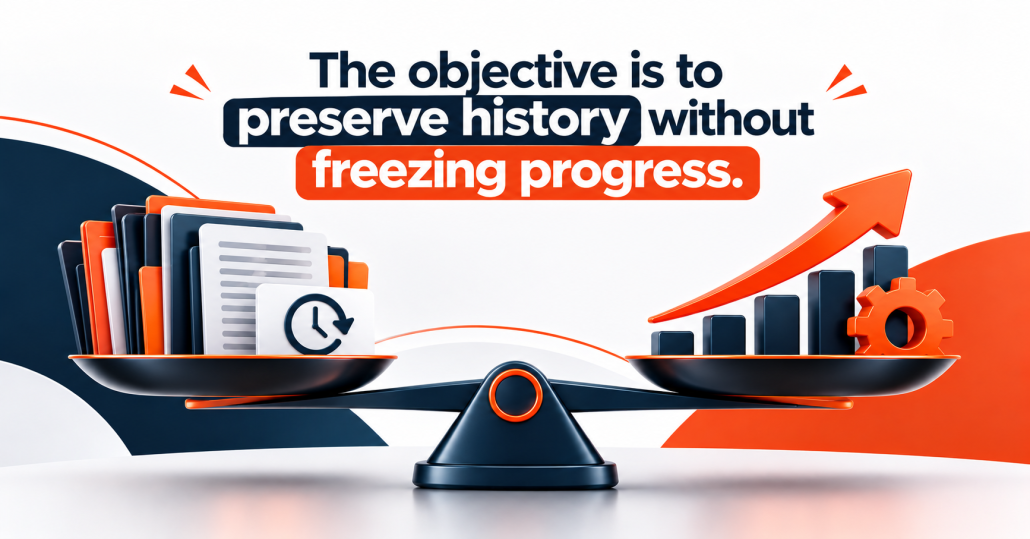
A defensible audit trail should preserve the relevant historical state of the data and logic, alongside subsequent corrections and changes. It should not require organisations to ignore better information or prevent systems from improving.
2.4 The decision itself disappears
Perhaps the most overlooked failure point is the absence of a formal record of the decision itself.
Imagine that a dashboard flags a supplier as high-risk. Procurement reviews the alert, consults the legal team, and decides to continue the relationship under additional monitoring rather than terminate the contract.
The decision may be reasonable. The team may have considered contractual obligations, alternative suppliers, delivery timelines, and the commercial cost of disruption.
But where is that reasoning recorded?
It might be spread across email threads, meeting notes, messaging applications, spreadsheets, and conversations between senior managers. The dashboard may retain the original risk score, but the justification for overriding its recommendation may never be connected to the record.
Months later, an auditor asks why the supplier remained approved despite the elevated risk.
The organisation can show the alert. It may be able to show the contract. It may even retrieve parts of the correspondence.
What it cannot readily demonstrate is the complete relationship between the risk signal, the evidence considered, the decision-maker’s rationale, the required approvals, and the action ultimately taken.
This is where institutional memory becomes a governance vulnerability.
Decisions are frequently made through a combination of data, human judgement, operational constraints, and approved exceptions. Those elements are not inherently problematic. In fact, they are often necessary for good management.
The problem is allowing them to remain disconnected.
An audit-ready organisation must be able to reconstruct not only what its systems reported, but also what its people decided, why they decided it, and whether they had the authority to do so.
3. The Missing Layer: A System of Decision Record
If dashboards are not designed to preserve the complete reasoning behind business actions, what should enterprises build around them?
The answer begins with a distinction between insight and evidence.
Insight helps an organisation recognise a pattern, identify an emerging risk, or understand a change in performance. Evidence establishes the factual and procedural basis for a particular action.
For example, an analytics platform may identify a region where customer acquisition costs have risen sharply. That insight alerts management to a potential problem.
The subsequent decision might be to reduce spending, change the sales strategy, or increase investment in a different market.
To defend that decision later, the organisation needs more than the original chart. It needs the relevant data, the assumptions applied, the alternatives considered where material, the approval record, and the rationale for the chosen course of action.
This is the purpose of a System of Decision Record: a governed capability that connects the evidence informing a decision with the decision itself and its resulting actions.
It does not need to replace existing reporting, data warehousing, workflow, or enterprise resource planning systems. Rather, it connects relevant information from these systems and preserves the context required to understand consequential decisions.
A well-designed decision record can establish:
- What was known: The relevant data, evidence, and information available at the time.
- How it was interpreted: The business rules, assumptions, model outputs, and constraints applied.
- Who was responsible: The individuals or roles that reviewed, recommended, approved, or executed the decision.
- Why the action was taken: The rationale, exceptions, and material considerations supporting the choice.
- What happened next: The action executed, its timestamp, and the outcome compared with the expected result.
This shifts governance from a retrospective exercise into an operational capability.
Instead of attempting to reconstruct the reasoning after a challenge arises, an organisation captures the relevant information as part of the decision-making process.
The difference is significant. A decision record is not simply a longer report or a collection of supporting documents. It is a structured relationship between evidence, logic, authority, action, and outcome.
The result is greater traceability across the decision lifecycle.
4. Anatomy of an Audit-Ready Decision
Not every operational choice requires the same level of documentation. A routine scheduling adjustment should not carry the same governance burden as a major credit decision, a regulatory determination, a material financial commitment, or an AI-assisted recommendation affecting customers.
The depth of the record should reflect the decision’s significance, risk, and applicable obligations.
Nevertheless, six components provide a useful foundation for audit-ready decision-making.
1. Inputs: Preserve the evidence available at the time
The record should identify the data and other evidence used to inform the decision.
Depending on the use case, this may include a versioned data snapshot, source references, the reporting period, relevant records, and the date and time at which the information was retrieved.
A link to a live dashboard may be useful, but it is not sufficient when the underlying data can change.
The objective is to establish what information was available to the decision-maker at the relevant moment, subject to appropriate privacy, retention, and access controls.
2. Assumptions: Make the context explicit
Decisions depend on assumptions about markets, customers, costs, capacity, risk tolerance, and operational constraints.
These assumptions can materially influence an outcome even when the underlying data is accurate.
For example, a revenue forecast may depend on a projected conversion rate, while a credit decision may depend on an approved affordability threshold.
Recording material assumptions makes it possible to understand the conditions under which the decision was considered reasonable.
Where assumptions change, the record should identify the relevant version and, where appropriate, who approved the change.
3. Logic and rules: Document how the evidence was interpreted
The record should identify the business rules, calculations, filters, transformations, model versions, or decision criteria that materially influenced the outcome.
This is especially important when the decision depends on automated processing or AI-generated recommendations.
A reviewer should be able to understand the applicable logic at the appropriate level of detail and determine whether it was approved for the intended use.
For AI-assisted decisions, this may also require model and prompt versions, relevant input references, output records, confidence information where available, and the human review applied. The exact requirements will depend on the system and the risk involved.
4. Approvals and governance: Establish who had authority
A defensible decision requires more than an identifiable user account.
The record should establish the relevant decision-maker, approval status, applicable delegation of authority, and any required reviews or exceptions.
Where an automated recommendation is overridden, the reason for the override and the authorised approver should be captured when required by the governing process.
This allows an organisation to distinguish between a decision that was merely made and one that was made through the appropriate control framework.
5. Timestamps and change history: Preserve the sequence of events
An audit-ready record should establish when the relevant information was captured, when the decision was made, when approval occurred, and when the action was executed.
It should also preserve material changes to the decision record and its supporting evidence.
Reliable timestamps, controlled access, version history, and appropriate tamper-evident or immutable storage mechanisms can help establish the integrity of this history.
The specific controls should reflect the organisation’s security architecture, risk profile, and regulatory requirements.
6. Outcomes and projections: Connect decisions to results
A decision record should not end when an action is approved.
Where appropriate, it should link the expected outcome to the result observed over time.
If management reallocates capital based on a forecast, the organisation should be able to compare the forecast with actual performance. If a risk model triggers additional monitoring, the resulting risk indicators should be available for review.
This creates a feedback loop that helps the organisation assess whether its assumptions remain valid, whether its decision rules are effective, and whether future decisions need to change.
It also prevents governance from becoming a purely administrative exercise. The record becomes a source of evidence about decision quality and business performance.
The six-part framework: Inputs → Assumptions → Logic and Rules → Approvals → Timestamps and Change History → Outcomes.
Together, these components provide the foundation for reconstructing a decision from the information that informed it through to the action taken and the result achieved.
They should be implemented proportionately, with stronger evidence and controls for decisions that carry greater financial, operational, legal, or reputational consequences.
5. From Business Intelligence to Decision Intelligence
The limitations of dashboard-led governance point to a broader shift in enterprise data strategy: the move from reporting performance to governing decisions.
Decision Intelligence (DI) brings together data, analytical methods, business context, decision processes, and feedback to improve how organisations make and manage decisions.
It is not simply another name for business intelligence, nor does it require enterprises to abandon their existing analytics investments.
Business intelligence remains essential for understanding what is happening across the organisation. Data platforms remain responsible for integrating and managing information. Workflow systems support operational execution, while governance and security controls establish how information and actions should be managed.
Decision Intelligence connects these capabilities around the decision itself.
Consider a financial institution using an existing data warehouse, BI dashboards, and credit risk models.
The dashboard identifies an application that falls outside the institution’s preferred risk threshold. The model provides a recommendation, but the application requires additional review because of a documented exception.
In a fragmented environment, the relevant evidence might be scattered across the dashboard, model logs, credit application, approval workflow, and email correspondence.
In a well-governed Decision Intelligence environment, the institution can connect the relevant evidence and model output to the decision workflow, record the authorised review and rationale, preserve the applicable versions, and track the resulting action.
The institution does not merely retain a risk score. It retains a structured record of how that score contributed to the final decision.
This is the difference between an analytics environment that supports decisions and a decision architecture that also supports accountability.
Decision traceability must be built into the process
There is an important implementation principle here: audit-readiness cannot depend entirely on employees remembering to document decisions after the fact.
If capturing the rationale requires opening another application, copying figures into a spreadsheet, and manually assembling supporting evidence, the process is likely to be inconsistent.
A more sustainable approach integrates evidence capture into existing workflows.
When a consequential decision is initiated, the system can retrieve the relevant data references, apply the approved decision logic, capture required reviews, record the final action, and preserve the history according to the organisation’s policies.
Human judgement remains part of the process where appropriate. Automated recommendations do not eliminate the need for accountability, and a system should not imply that an AI-generated answer is correct merely because it has been recorded.
The goal is to make the decision process traceable by design.
This also requires clear ownership. Business teams must define decision policies and acceptable exceptions; data teams must maintain reliable lineage and definitions; technology teams must implement secure integrations and controls; and risk and compliance teams must establish the evidence required for different decision classes.
Decision Intelligence works best when these responsibilities are connected through a shared operating model rather than treated as isolated technology projects.
6. Why Audit-Readiness Is a Business Advantage
Audit-readiness is often discussed as a compliance requirement. That framing is incomplete.
A well-governed decision environment can create operational, financial, and strategic advantages long before an external auditor requests evidence.
Faster, more efficient audits
When supporting evidence, decision logic, approvals, and relevant history are linked, teams spend less time searching across systems and chasing former decision-makers for context.
Audit preparation becomes a process of retrieving and validating existing records rather than reconstructing events from incomplete documentation.
The benefit is not that every audit becomes effortless. Reviewers may still identify weaknesses, request additional evidence, or challenge the underlying judgement.
The benefit is that the organisation starts with a stronger evidential foundation.
Lower costs of compliance and investigation
Manual evidence gathering consumes time across finance, operations, technology, legal, and compliance teams.
A structured decision record can reduce repetitive reconciliation, document collection, and investigation work. It can also help organisations identify gaps in controls earlier, before those gaps become expensive incidents.
The actual financial benefit will depend on the number and complexity of decisions, the existing maturity of governance processes, and the extent to which evidence collection can be automated.
Better continuity when people leave
Institutional knowledge should not disappear when an executive resigns, a team is reorganised, or an employee who owns a critical spreadsheet moves on.
When the reasoning behind material decisions is documented in a governed system, the organisation becomes less dependent on individual memory.
Successors can understand not only what was decided but also the assumptions, constraints, and approvals that shaped the decision.
This is especially valuable in enterprises where decisions span several departments or remain relevant for years.
Greater confidence in strategic decisions
Executives regularly make decisions under uncertainty. They allocate capital, enter markets, change pricing, restructure operations, and adjust risk appetite using imperfect information.
A decision record provides a way to revisit those choices with greater discipline.
Leaders can distinguish between a decision that was reasonable given the information available at the time and one that failed because its assumptions were flawed, its controls were inadequate, or its execution differed from the approved plan.
That distinction supports organisational learning without relying on hindsight alone.
Stronger governance for AI-assisted decisions
As enterprises introduce AI into customer service, lending, fraud detection, procurement, forecasting, and internal operations, the relationship between model output and human accountability becomes increasingly important.
An AI system may generate a recommendation, but the organisation still needs to understand the data and rules involved, the limits of the system, the human oversight applied, and the action taken.
Decision traceability can support model governance, risk management, internal controls, and explainability processes. It does not, by itself, guarantee regulatory compliance or prove that a model is fair, accurate, or appropriate.
Those outcomes require additional technical, operational, and governance controls.
The broader point is that an organisation’s ability to explain how consequential decisions were made is becoming as important as its ability to make them quickly.
7. A Practical Self-Assessment: Would Your Dashboards Survive an Audit?
Before investing in new technology, enterprise leaders should assess whether their existing environment can reconstruct a consequential decision from start to finish.
Consider the following five questions.
1. Can you reproduce the exact data state behind a major decision made six months ago?
Not merely the latest dashboard view, but the relevant historical inputs, transformations, and business logic.
2. Is the rationale behind material overrides and exceptions recorded centrally?
Can you establish why a recommendation was rejected, a threshold was bypassed, or a policy exception was approved?
3. Can different department heads agree on the lineage and definition of a critical business metric?
If Finance, Sales, Risk, and Operations report different versions of the same KPI, can the organisation explain the differences and identify the approved definition for the decision in question?
4. Can you identify who approved a material change to a reporting rule, model, or decision process?
Is there a reliable history of the change, the relevant authorisation, its effective date, and its impact on subsequent decisions?
5. Could an independent reviewer reconstruct why a major strategic choice was made if the key people involved were no longer available?
Can the reviewer connect the evidence, assumptions, approvals, rationale, and actions without depending on undocumented conversations or personal recollection?
If any answer is no, the issue may extend beyond dashboard design. It may indicate a gap in the organisation’s decision governance and evidence architecture.
A useful next step is to select one high-impact decision process, such as credit approval, supplier risk, capital allocation, or AI-assisted customer assessment, and trace a real decision through its complete lifecycle.
Identify which evidence exists, where it resides, what can be reproduced, and which parts of the rationale or approval history are missing.
This exercise will help determine whether the immediate need is better data lineage, stronger metric governance, improved workflow controls, a more reliable audit trail, or a broader Decision Intelligence capability.
The objective is not to document everything indiscriminately. It is to establish a proportionate and repeatable way to defend the decisions that matter most.
Conclusion: Build for the Questions You Will Eventually Be Asked
A polished dashboard can demonstrate that an organisation has invested in data. It cannot, on its own, demonstrate that the organisation makes defensible decisions.
That distinction matters because enterprise accountability extends beyond the accuracy of individual metrics. It includes the evidence available at the time, the logic used to interpret that evidence, the authority under which decisions were made, and the actions that followed.
Traditional BI remains an essential part of this equation. But as decision-making becomes more distributed, automated, and dependent on AI, reporting alone is not enough.
Enterprises need to connect data lineage with decision lineage, insight with evidence, and analytics with governance. They need systems that preserve the context of consequential decisions as those decisions happen, rather than relying on teams to reconstruct that context when scrutiny arrives.
This is the opportunity for Decision Intelligence: not simply to help organisations make faster or better-informed decisions, but to help them understand, govern, and defend those decisions throughout their lifecycle.
The question for enterprise leaders is no longer just whether their dashboards tell them what is happening.
It is whether their organisations can explain why they acted, prove that the appropriate controls were followed, and learn from the results.
Do not wait for an audit notification to discover that your reporting environment cannot reconstruct the decisions it helped shape. Build the evidence into the decision process itself.
Ready to move from reporting to decision accountability?
DIP’s video
Descasio’s Decision Intelligence Platform (DIP) is positioned to help enterprises connect business insights with the context and governance needed for more traceable decision-making.
If your organisation is looking to move beyond dashboards towards a more structured approach to decision governance, explore how Decision Intelligence can support your existing data and analytics environment.
[Book a conversation with Descasio to explore Decision Intelligence for your enterprise.]https://dip.descasio.io/