Imagine your organisation uses AI to assess credit risk, flag suspicious transactions, or guide critical business decisions. The system produces a recommendation, your team acts on it, and everything appears to be working as expected.
Then someone asks a simple question: Where did the data behind that decision come from?
Can your team answer confidently?
Can you demonstrate that the data was reliable, appropriately sourced, and suitable for the decision? Can you explain how it was processed and who is accountable for the outcome?
For many organisations, these questions are harder to answer than they should be.
As businesses adopt AI across their operations, the conversation is shifting beyond what these systems can do to whether organisations can explain, govern, and defend how they use them. For business leaders, understanding the data behind AI is becoming an important part of managing risk and building trust.
AI Accountability Starts With the Data
AI systems are only as dependable as the processes and information supporting them. Incomplete customer records, outdated datasets, inconsistent reporting, and poorly documented data sources can all undermine the reliability of AI-driven insights.
The challenge is that these weaknesses may not be immediately visible.
An AI system can produce a convincing recommendation without revealing the limitations of the information behind it. If the organisation cannot trace that information to its source, identifying errors, investigating outcomes, and demonstrating accountability becomes much harder.
This matters particularly in banking, where AI may support credit assessments, fraud detection, customer verification, and risk monitoring.
In these environments, an incorrect outcome is not simply a technical issue. It can affect customers, exposehe institution to risk, and raise questions about the controls surrounding its decision-making processes.
Five Questions Your Organisation Should Be Ready to Answer
Regulatory expectations vary by jurisdiction, industry, and use case. However, organisations using AI in consequential business processes should be prepared to explain several fundamental aspects of their data practices.
1. Where Does Your AI Data Come From?
Organisations need to understand the origins of the data their AI systems use.
Is it drawn from internal records, third-party providers, customer interactions, or external datasets? Was it obtained and used appropriately? Are its sources documented?
Without this visibility, organisations may struggle to establish whether the data is suitable for its intended purpose or whether its use introduces privacy, security, or reliability concerns.
2. How Reliable Is the Data?
Data can be available without being dependable.
Missing records, outdated information, duplicate entries, and inconsistencies across systems can affect the quality of AI outputs. Data that does not adequately represent the intended population can also contribute to biased or misleading results.
Organisations need processes for assessing data quality, identifying limitations, and determining whether information remains fit for purpose.
3. Can You Trace How the Data Was Changed?
Data rarely moves directly from its original source into an AI system without some form of processing.
It may be cleaned, combined, transformed, labelled, or enriched along the way. Each step can affect how the information is interpreted.
Maintaining records of these changes helps organisations investigate unexpected outcomes and understand how the information supporting a decision was produced. The National Institute of Standards and Technology’s AI risk management guidance highlights the importance of documenting data origins, lineage, transformations, and dependencies.
4. Can You Explain the Decisions It Influences?
Knowing where data comes from is only part of the challenge. Organisations must also understand how it informs their AI systems and the decisions made using their outputs.
For example, if an AI-assisted credit assessment produces an unexpected result, can the relevant teams investigate the information involved, understand the system’s role, and determine what action is appropriate?
The level of explanation required will depend on the application. However, organisations should establish clear documentation, appropriate oversight, and procedures for investigating consequential outcomes.
5. Who Is Accountable When Something Goes Wrong?
AI does not remove organisational responsibility.
Leadership teams need clarity on who oversees AI systems, who manages data-related risks, who approves changes, and who responds when an issue arises.
This responsibility may involve several functions, including IT, data management, risk, compliance, and business operations.
Without clear ownership, even a well-intentioned governance policy can become difficult to implement in practice.
The Governance Gap: Having Data Is Not the Same as Controlling It
Answering these questions requires more than a collection of policies or a one-time compliance review.
Organisations need visibility into their data, consistent governance practices, documented processes, and a clear understanding of how information supports business decisions.
In Nigeria, this is especially relevant for businesses operating in regulated sectors. Although Nigeria does not have a standalone AI law in force as of October 2026, existing legal and sector-specific requirements can still apply to AI deployments. For example, the Nigeria Data Protection Act is relevant when AI involves personal data, while financial institutions must consider applicable Central Bank of Nigeria requirements.
The practical implication for business leaders is clear: waiting for a regulation that specifically addresses every AI use case is not a substitute for establishing sound data governance today.
Organisations should understand their AI use cases, assess the risks, document their data practices, and ensure the appropriate teams can demonstrate how relevant controls operate.
Building a Stronger Foundation for AI Accountability
For many organisations, the difficulty lies in connecting information that sits across different systems, departments, and reporting processes.
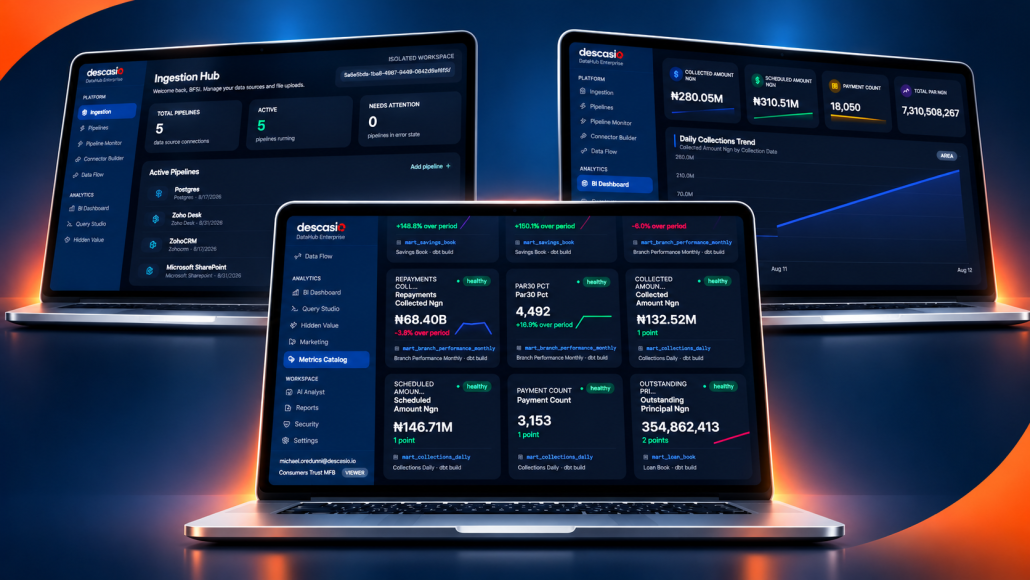
This is where Descasio’s Decision Intelligence Platform (DIP) becomes relevant to the conversation.
As organisations work towards more trustworthy, data-informed decisions, the goal is to strengthen the relationship between their data, the insights generated from it, and the decisions those insights inform.
Descasio’s work in decision intelligence aligns with this broader need to help organisations make better use of their data. For businesses preparing to scale AI adoption, the next step is to establish how their existing data environment and governance processes can support greater visibility, traceability, and accountability.
The specific capabilities required will depend on the organisation’s systems, regulatory obligations, and AI applications.
Before Your Next AI Deployment, Ask These Questions
Before introducing AI into another business process, leaders should ask:
- Do we know where the data supporting this system originates?
- Can we demonstrate how that data is processed and maintained?
- Have we assessed its quality, suitability, and potential limitations?
- Can we investigate the information behind an unexpected outcome?
- Have we assigned clear responsibility for data governance and AI oversight?
These questions can help identify gaps before they become operational, reputational, or compliance concerns.
Trust Your Data Before You Trust the Decision
AI adoption is moving quickly, but responsible adoption requires more than deploying capable technology. It requires organisations to understand the information behind their systems and establish the controls needed to use it appropriately.
For CEOs and business leaders, the priority is to make AI data governance part of the organisation’s wider risk and decision-making strategy, rather than treating it as a technical task delegated entirely to IT.
Because when questions arise about an AI-driven decision, having the technology is not enough. Your organisation must be able to explain the data behind it.
Descasio is helping organisations build a stronger foundation for data-informed decisions. Explore how the Decision Intelligence Platform can support your organisation’s data and decision-making priorities.