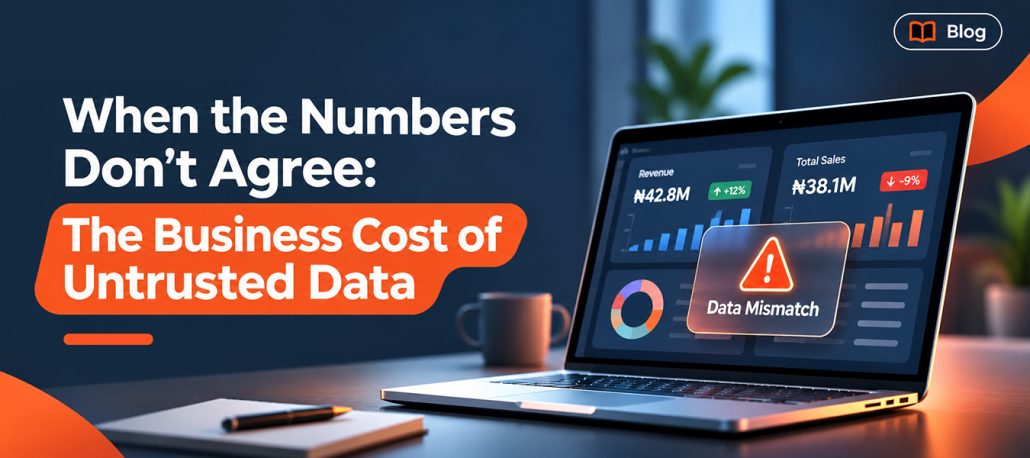
Every organisation wants to be data-driven. But what happens when the numbers telling the story of your business don’t agree?
Finance reports one revenue figure. Sales presents another. Operations has a different explanation for the gap. Suddenly, a leadership meeting intended to drive business decisions becomes a debate about whose numbers are correct.
For CEOs, this is more than a reporting inconvenience. It raises a bigger question: if your teams cannot agree on what is happening in the business, how confidently can you decide what happens next?
In banking and fast-moving consumer goods (FMCG), where decisions affect profitability, risk, customer experience, and operational performance, the cost of untrusted data can be significant.
The Business Cost You Don’t See on the Balance Sheet
Untrusted data rarely appears as a single expense in financial reports. Instead, its costs accumulate across the organisation.
Teams spend hours reconciling conflicting reports. Executives wait for revised figures before approving decisions. Forecasts become less reliable, and resources may be directed towards the wrong priorities.
A delayed decision can mean a missed market opportunity. An unreliable forecast can lead to excess inventory or lost sales. Inconsistent reporting can prevent leaders from identifying risks before they escalate.
These costs are easy to overlook because they are spread across departments. Yet, collectively, they can undermine the value an organisation expects to gain from its data investments.
The problem is not necessarily that the business lacks information. It is that leaders cannot confidently act on the information they have.
Banking: When Inconsistent Data Creates Risk
For banks, data reliability is fundamental to risk management, regulatory compliance, and customer trust.
Consider a credit decision based on incomplete customer records or conflicting financial information. The institution may struggle to assess exposure accurately. Similarly, fragmented transaction data can complicate fraud monitoring, while inconsistent reports can make regulatory reporting more difficult.
These challenges create uncertainty where precision matters most.
Banking leaders need more than dashboards showing financial performance. They need confidence in the information behind those reports, the ability to investigate discrepancies, and a dependable basis for decisions that carry financial and regulatory consequences.
FMCG: When the Numbers Don’t Reflect the Market
For FMCG businesses, unreliable data can quickly become an operational problem.
Sales figures inform distribution strategies. Inventory records influence replenishment. Demand forecasts shape production and resource allocation.
But when the information behind these decisions is incomplete, outdated, or inconsistent, the business can lose sight of what is happening on the ground.
One region may have excess stock while another experiences shortages. Sales performance may look healthy on paper while distribution gaps remain unresolved. Promotional spending may continue without a clear picture of its actual impact.
For leaders managing multiple products, distributors, and markets, these gaps make it harder to respond to changing demand and allocate resources effectively.
The consequences differ between banking and FMCG, but the underlying issue is the same: decisions are only as dependable as the information supporting them.
More Dashboards Won’t Fix a Trust Problem
When organisations struggle with data, investing in another reporting tool or analytics platform can seem like the obvious answer.
A dashboard can present conflicting information in a polished format. AI can analyse data at scale, but unreliable inputs can undermine the usefulness of its outputs.
Without consistent definitions, clear data ownership, and visibility into where information originates, organisations risk making existing problems faster and more difficult to detect.
The real question is not how many reports a business can generate. It is whether decision-makers can trust the information those reports contain.
From Conflicting Reports to Confident Decisions
Solving this problem requires organisations to look beyond individual reports and disconnected systems. They need stronger foundations for managing, understanding, and using data across the business.
That means improving visibility into data sources, strengthening governance and accountability, and making information more dependable for reporting, analysis, and decision-making.
This is where Descasio’s Decision Intelligence Platform (DIP) comes into the conversation.
DIP supports the broader ambition of helping organisations make more informed, data-driven decisions. It reflects an important shift in business intelligence: moving beyond collecting information towards making that information useful in the decisions that shape business outcomes.
For banking and FMCG leaders, the opportunity is to build a stronger connection between organisational data, business insights, and the actions that follow.
Five Questions Every CEO Should Ask
Before investing further in analytics or AI, business leaders should ask:
- Do our departments arrive at the same figures when reporting the same business metric?
- Can we trace important business figures back to their sources?
- How much time do our teams spend reconciling reports instead of acting on insights?
- Can we explain the information behind our most critical financial and operational decisions?
- Are our data foundations reliable enough to support our AI ambitions?
The answers can reveal whether data is helping the organisation move forward or quietly creating friction across its operations.
Trust Your Data. Defend Every Decision.
When the numbers don’t agree, the consequences extend beyond reporting. They affect how quickly leaders act, how effectively teams operate, and how confidently organisations prepare for the future.
For CEOs, the priority is to make data reliability a business concern rather than a problem left entirely to the IT department.
Descasio’s Decision Intelligence Platform is part of this conversation, supporting the pursuit of more informed, data-driven decisions.
Because competitive advantage does not come from having more numbers. It comes from knowing which numbers to trust, understanding what they mean, and acting on them with confidence.
Explore how Descasio can help your organization build greater confidence in its data and decisions.https://dip.descasio.io/