
Every business wants to operate efficiently. But in many organisations, some of the most important business processes still depend on spreadsheets, email threads, shared documents and manual follow-ups.
A procurement request is sent by email. An invoice is recorded in a spreadsheet. A manager is asked to approve a purchase, but the request gets buried beneath other messages. Someone follows up. Someone else forwards the email. A few days later, the team is still trying to establish who has approved what.
Individually, these activities may seem harmless. After all, spreadsheets and email are useful business tools. They help teams communicate, organise information and manage everyday tasks.
The problem begins when these tools become the backbone of critical business operations.
As an organisation grows, the volume of requests, approvals, transactions and internal communication increases. Processes that once worked for a small team can become difficult to manage across multiple departments, locations and decision-makers.
The result is an operational cost that rarely appears as a separate line on the company’s financial statements: lost time, delayed decisions, duplicated work and limited visibility into how the business operates.
For business leaders, the question is no longer whether spreadsheets and email are useful. It is whether they are still the right tools for managing increasingly complex business processes.
The Problem Is Not the Tools. It Is How Businesses Depend on Them.
Spreadsheets and email are not inherently inefficient. They become a problem when organisations use them to manage processes that require consistent tracking, multiple approvals, clear ownership and accountability.
Consider a business with a procurement process involving four departments.
An employee raises a purchase request. The request is sent to a line manager, then forwarded to finance, followed by procurement and finally an executive for approval.
If this process is managed entirely through email, every stage depends on someone remembering to forward a message, check an inbox or follow up with the next person.
The spreadsheet might show that a request is pending, but it may not explain who currently has responsibility for it or why it has been delayed.
Now multiply that process across hundreds of requests, invoices, employee activities and operational tasks.
What started as a convenient way to manage work becomes a system that requires constant human intervention just to keep things moving.
This is where the hidden cost begins.
1. Time Lost to Manual Follow-ups and Repetitive Administrative Tasks
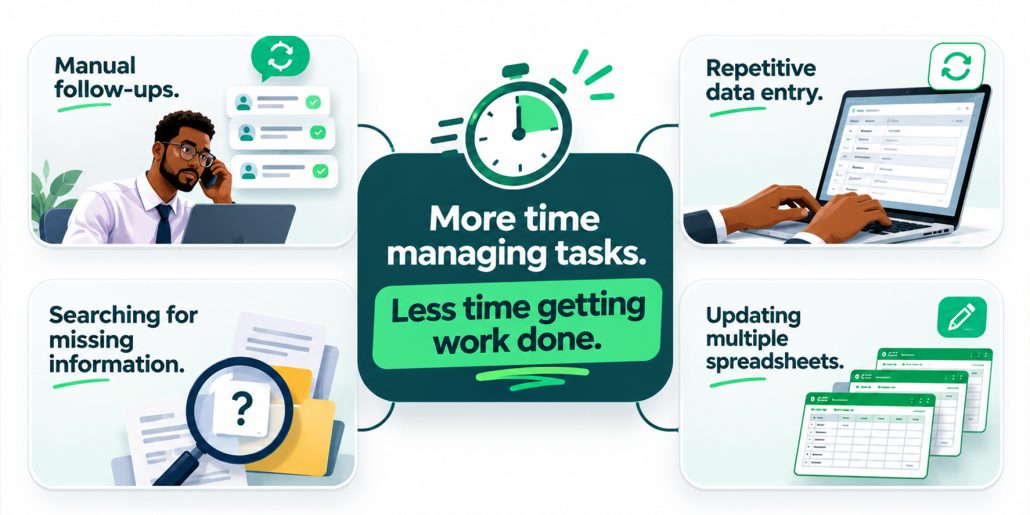
One of the biggest costs of manual business processes is the amount of employee time spent managing work instead of completing it.
Employees regularly spend time:
- Sending reminders to managers about pending approvals.
- Updating spreadsheets with the latest request status.
- Searching through email conversations for missing documents.
- Re-entering information across different files and systems.
- Following up with departments to confirm whether an action has been completed.
These tasks may take only a few minutes individually. However, when they happen repeatedly across departments, the accumulated time becomes significant.
For example, an operations manager who spends 15 minutes every morning checking pending requests and sending reminders loses more than an hour each working week to a task that could be handled through automated notifications and workflow tracking.
Across an entire department, the impact can be considerably greater.
The issue is not simply that employees are busy. It is that valuable working hours are being consumed by administrative activities that do not necessarily require manual attention.
For business leaders, this raises an important question: How much of your workforce’s time is spent moving processes forward rather than creating actual business value?
2. Approval Delays Can Slow Down Business Decisions
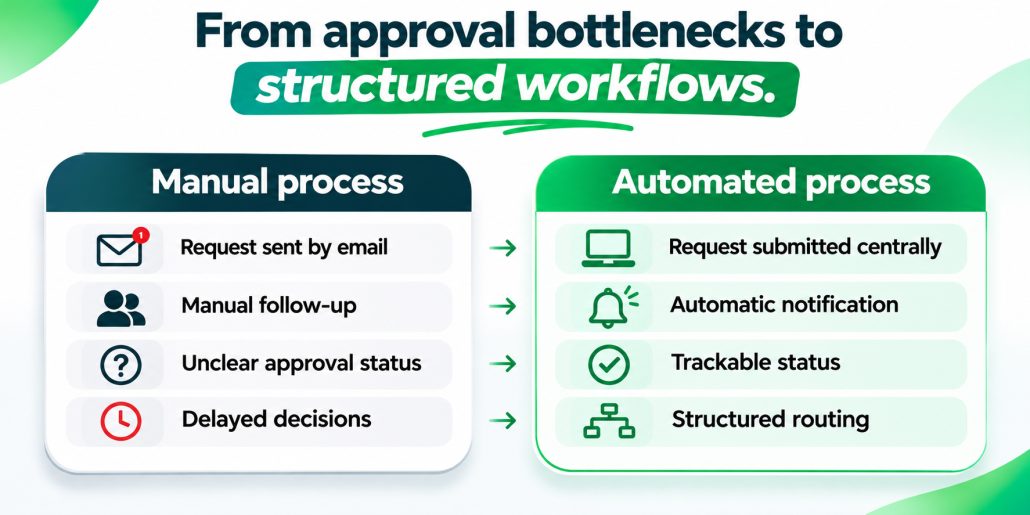
In many organisations, approvals are essential to keeping operations moving.
Procurement, expense management, vendor onboarding, budget allocation and employee requests all depend on decisions being made at the right time.
When these processes rely on email, delays can occur at almost every stage.
An approval request may be sent to the wrong person. A manager may be unavailable. Supporting documents may be missing. A request may remain unanswered because nobody has a clear view of its status.
The consequences extend beyond administrative inconvenience.
A delayed procurement approval can affect purchasing timelines. A pending vendor approval can hold up a project. An unresolved expense request can create unnecessary pressure on finance teams.
These delays can also affect relationships with suppliers, employees and other business stakeholders.
The challenge is that businesses often measure how long a task takes to complete without examining how much time is lost waiting for someone to act.
A more efficient approval process should make it clear:
- Who needs to review a request?
- What action is required?
- When should the action be completed?
- What happens if an approval is delayed?
- Who can see the current status?
Without these controls, even a relatively simple approval process can become a source of operational friction.
3. Limited Visibility Creates Accountability Gaps
Leadership teams need reliable information to make decisions.
They need to understand what is happening across departments, which activities are progressing, where delays are occurring and who is responsible for outstanding actions.
However, when business processes are spread across emails, spreadsheets and individual documents, getting that information can become difficult.
A finance manager may have one version of an expense tracker, while the operations team maintains another. A department head may have to request updates from several employees before understanding the status of outstanding approvals.
This creates several challenges:
Fragmented information: Important records are stored in different locations, making it difficult to establish a single, reliable view of a process.
Unclear ownership: When responsibilities are not clearly assigned, requests can remain unattended because everyone assumes someone else is handling them.
Difficult tracking: Managers may struggle to identify where a request is in the approval process without contacting the people involved.
Limited auditability: Reconstructing who submitted, reviewed or approved a request can require searching through multiple email conversations and documents.
For organisations handling sensitive financial, procurement or employee processes, these gaps can become particularly important.
Accountability should not depend on someone’s ability to remember an email conversation.
It should be built into the process itself.
4. Manual Processes Become More Expensive as Businesses Grow
A process that works for ten employees may not work as effectively for one hundred.
As businesses expand, they deal with more employees, suppliers, customers, transactions and internal requests. The number of people involved in decision-making also increases.
What once required one manager’s approval may now involve several departments, different approval limits and additional compliance requirements.
Trying to manage this growth using the same manual processes can create unnecessary complexity.
Businesses may respond by adding more administrative staff, creating additional spreadsheets or introducing more reporting procedures.
But adding people to manage an inefficient process does not necessarily solve the underlying problem.
It can simply increase the amount of coordination required.
Growing organisations need processes that can handle increasing workloads without requiring a corresponding increase in manual administration.
This is where workflow automation becomes an important part of operational planning.
Why Businesses Need to Move Beyond Manual Workflows
The goal is not to eliminate spreadsheets or email from the workplace.
Both remain useful for communication, reporting and managing information.
The goal is to stop relying on them as the primary systems for processes that require structure, accountability and continuous tracking.
Workflow automation helps organisations define how work should move from one stage to another.
Instead of relying on employees to remember every action, an automated workflow can manage routine steps according to predefined rules.
For example, a procurement approval process can be structured so that:
- An employee submits a purchase request through a centralised process.
- The request is automatically routed to the appropriate manager.
- Finance receives the request when its review is required.
- Additional approvals are triggered based on the organisation’s approval rules.
- Relevant stakeholders receive notifications about outstanding actions.
- The request status is updated as it moves through the process.
- Every action is recorded for future reference.
This creates a more consistent way of working.
Employees know what is expected of them, managers can see what requires attention, and leadership teams have better visibility into operational activities.
The result is not simply faster administration. It is a more structured approach to managing business operations.
How PlugIQ Helps Organisations Move from Manual Processes to Automated Workflows
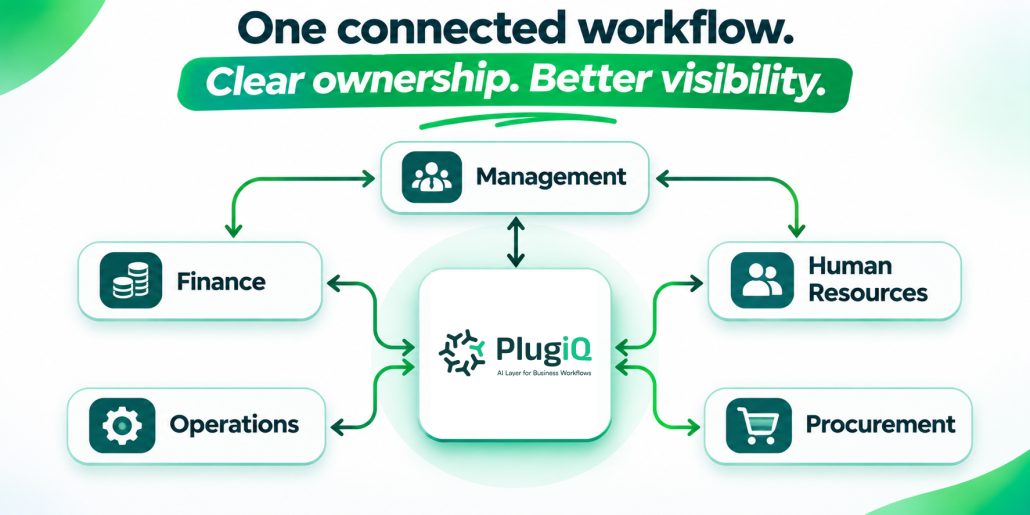
This is where PlugIQ comes in.
PlugIQ, Descasio’s intelligent workflow automation platform, helps organisations move away from fragmented, manual processes towards structured, trackable and automated operations.
Rather than depending on email conversations and separate spreadsheets to manage approvals, businesses can build workflows that define how requests are submitted, reviewed, routed and completed.
With PlugIQ, organisations can:
Centralise Business Processes
Bring critical requests and approval activities into structured workflows, reducing dependence on scattered email conversations and disconnected documents.
Automate Approval Routing
Direct requests to the appropriate people based on predefined business rules, departments, approval levels and other requirements.
Improve Process Visibility
Give employees, managers and decision-makers clearer visibility into pending requests, completed actions and outstanding approvals.
Strengthen Accountability
Maintain a record of workflow activities, including submissions, approvals, comments and other actions, through built-in audit trails.
Scale Without Increasing Administrative Complexity
Create processes that can support growing teams and increasing business activity without requiring employees to manually coordinate every stage.
PlugIQ also includes no-code workflow building capabilities, allowing teams to create and customise approval processes without relying entirely on developers or lengthy IT implementation cycles.
It can also connect with existing business applications, including Gmail, Outlook, Google Drive, OneDrive, Google Sheets and Excel.
This means organisations do not necessarily have to abandon the tools they already use. They can build more structured processes around their existing business environment.
How Do You Know When Your Business Has Outgrown Manual Workflows?
Not every business needs to automate every process immediately.
However, there are signs that existing methods may no longer be sufficient.
Consider the following questions:
- Do employees regularly chase managers for pending approvals?
- Are important requests frequently buried in email conversations?
- Do different departments maintain separate versions of the same information?
- Is it difficult to identify who is responsible for an outstanding request?
- Does management have to request manual updates to understand operational progress?
- Are employees spending more time coordinating tasks than completing them?
- Does increasing business activity create more administrative pressure?
If several of these situations sound familiar, it may be time to review how your organisation manages its workflows.
A practical starting point is to identify one repetitive, high-volume process that regularly creates delays.
Map out how it currently works, identify where information gets stuck and determine which activities could be automated.
From there, organisations can introduce improvements gradually, measure the results and expand automation to other departments.
The objective is not to automate for the sake of technology. It is to improve processes in ways that support measurable business outcomes.
The Bigger Business Question: Are Your Processes Built to Support Growth?
Businesses do not usually outgrow spreadsheets and email overnight.
It happens gradually.
More requests come in. More people become involved in approvals. More documents need to be reviewed. More time is spent following up, updating records and trying to establish where things stand.
Eventually, the administrative effort required to keep operations moving becomes a challenge in itself.
For CEOs, COOs, CFOs and Operations Managers, this is an important operational consideration.
Growth should not mean creating more complexity around everyday business activities.
Organisations need systems that make work easier to track, decisions easier to manage and responsibilities easier to establish.
Spreadsheets and email will continue to have their place in business. But critical processes need more than a collection of documents and inbox reminders.
They need structure, visibility and accountability.
With workflow automation, businesses can move beyond manually coordinating every task and begin building operations that are designed to scale.
Ready to move beyond manual workflows?
Discover how PlugIQ can help your organisation automate approvals, improve operational visibility and manage business processes more efficiently.
Explore PlugIQ or request a demo to see how workflow automation can work for your organisation.https://plugiq.io/contact/