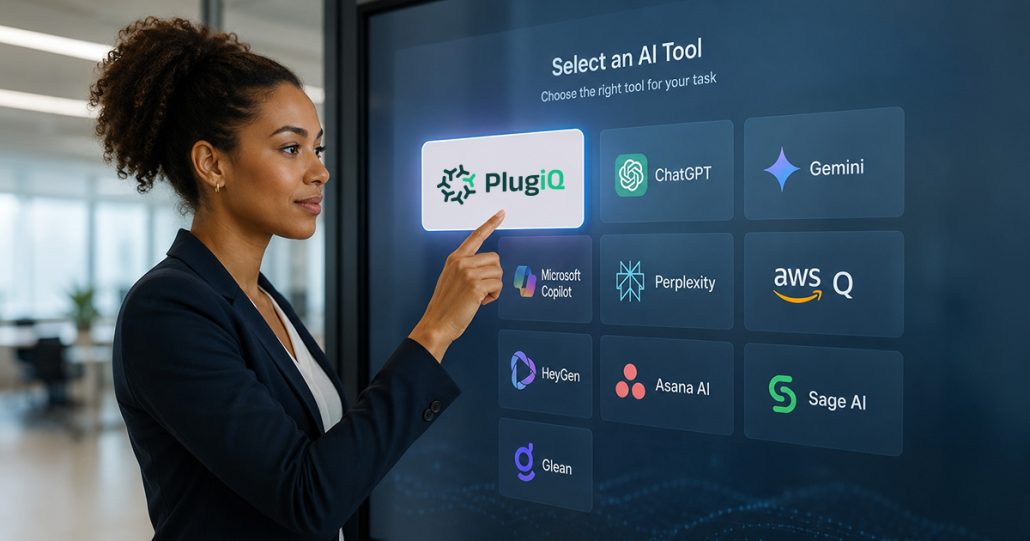
Since the start of the third industrial revolution in the mid-20th century, businesses have moved through cycles of digitization. We transitioned from the physical filing cabinets of the 60s to the cloud-hosted giant servers of the late 90s and early 2000s. However, as we cross into 2026, we are witnessing a shift more profound than the internet boom: the Autonomous Revolution.
In this era, digital tools no longer just “store” or “display” data; they reason with it. The advantages of adopting AI automation today—time optimization, hyper-personalized customer retention, and the elimination of manual “busywork”—are no longer competitive edges; they are requirements for survival.
Table of Contents
- The Evolution of Infrastructure: From GAFAM to Foundational AI
- The Rise of AaaS
- The 26 AI Automation Tools for 2026
- Communication & Knowledge Management
- Customer Relationship & Support
- Financial Operations & Accounting
- Operations & Workflow
- Marketing & Content Generation
- Cloud Infrastructure & Development
- Human Resources & Talent Management
The Evolution of Infrastructure: From GAFAM to Foundational AI
The “Big 5″—Google, Apple, Facebook (Meta), Amazon, and Microsoft—still dominate the landscape, but their roles have shifted. In 2026, they are no longer just service providers; they are the “Foundational Orchestrators.”
Where we once used Microsoft for spreadsheets and Google for search, we now use their Large Language Models (LLMs) to run entire business departments. The “Rise of GAFAM” has evolved into the “Dominance of Intelligence Providers,” where every click is assisted by an AI agent integrated directly into the OS.
The Rise of AaaS
Choosing the right tool in 2026 requires a mindset shift. You are no longer looking for “Software as a Service” (SaaS); you are looking for “Agents as a Service” (AaaS). An organization might use PlugiQ to build an entire internal compliance workflow in minutes, while a logistics company relies on Glean to index every internal document. The goal is to move from tools that require manual input to agents that provide autonomous outcomes.
The 26 AI Automation Tools for 2026
Communication & Knowledge Management
1. Microsoft Copilot (for Business)
Microsoft Teams is now an AI-first command center. Copilot doesn’t just transcribe meetings; it generates action items, identifies sentiment, and provides a summary of missed discussions. It is the gold standard for all-in-one corporate AI.
2. Perplexity for Business
In 2026, traditional search is dead. Perplexity serves as a real-time research engine that cites sources and compiles reports, providing verified intelligence without the “hallucinations” of earlier AI models.
3. Zoom AI Companion
Zoom is a workspace collaborator. Its AI Companion can draft meeting follow-up emails, summarize chat threads, and provide real-time coaching for presenters to improve their delivery during live pitches.
4. Slack AI
Slack AI allows you to “summarize channels” instantly, find information buried in months of conversations, and automate complex workflows through “Huddles” that automatically generate meeting minutes.
5. Jasper (Enterprise)
Jasper is an end-to-end AI marketing co-pilot. It learns your brand’s specific voice and automates multi-channel campaigns, ensuring AI-generated content sounds human-led.
Customer Relationship & Support
6. Zendesk AI
Zendesk has moved beyond ticketing into “Autonomous Service.” Its AI agents now handle over 80% of routine inquiries with human-like empathy, escalating only the most complex cases.
7. Intercom Fin
Fin uses your company’s own help center data to answer questions and can perform actions—like processing a refund or updating a subscription—directly within the chat interface.
8. Salesforce Einstein
The world’s #1 CRM is now fully predictive. Einstein identifies which leads are most likely to close and automatically drafts personalized outreach sequences for sales teams.
9. HubSpot Content Hub
HubSpot’s Content Hub allows you to take one blog post and automatically remix it into 20 social posts, three emails, and a podcast script, maintaining lead-tracking data throughout.
Financial Operations & Accounting
10. Sage AI (Sage Business Cloud)
Sage now features “Continuous Accounting,” monitoring transactions in real-time to flag anomalies and predict cash flow shortages months in advance.
11. Glean
The “Google for your company’s internal data.” Glean automates the discovery of contracts, invoices, and historical spend data across disparate systems like Google Drive, Slack, and Salesforce.
12. Rippling AI
Rippling AI automates “people operations”—calculating global taxes, managing benefits, and running payroll across 100+ countries without manual intervention.
13. Ramp (AI Expense Management)
Ramp uses AI to automatically categorize expenses, find duplicate subscriptions, and negotiate better rates with vendors on your behalf.
Operations & Workflow
14. PlugiQ
In 2026, the bottleneck for most companies isn’t a lack of tools, but a lack of integration. PlugiQ addresses this challenge as an intelligent automation workflow platform designed to help businesses automate their internal and external processes. At the core of its functionality is the Build Copilot, an AI feature that enables businesses to generate complex approval workflows—for procurement, expenses, compliance, or HR—simply by describing them in natural language.
Beyond workflow creation, PlugiQ seamlessly integrates with existing systems such as ERP, CRM, and collaboration tools, ensuring uninterrupted data flow. The result is a transformation of slow, manual tasks into efficient, audit-ready automated workflows delivered in minutes.
15. Notion AI
Notion has become the central “Brain” of the modern office. Its AI can summarize entire databases, draft project specs, and “fill in the blanks” for missing data in a project tracker.
16. Asana AI
Asana AI focuses on “Resource Management,” automatically calculating team bandwidth, identifying bottlenecks, and reassigning tasks to prevent burnout.
17. Miro Assist
Miro Assist can take a cluster of messy sticky notes and instantly group them by theme, generate mind maps from a single prompt, and turn a brainstorming session into a structured project plan.
Marketing & Content Generation
18. Adobe Firefly (Enterprise)
Firefly allows brands to generate “commercially safe” images and videos that adhere strictly to brand guidelines, enabling the production of thousands of ad variations in minutes.
19. Canva Magic Studio
Canva democratizes high-end design. Magic Studio can take a rough sketch and turn it into a professional presentation or instantly change the background of a product photo.
20. Gemini (Google)
By 2026, Gemini has evolved into the ultimate multimodal marketing analyst. Deeply integrated with Google Workspace and Search, it can ingest vast amounts of real-time market data to identify emerging consumer trends before they go viral. For businesses, Gemini acts as a high-level strategist that can draft reports, visualize data trends, and manage “Google Ads” campaigns autonomously based on live performance metrics.
21. HeyGen
HeyGen allows you to create AI avatars that speak 40+ languages with perfect lip-syncing. One video recorded in English can be automatically “translated” for global marketing.
22. ChatGPT (OpenAI)
ChatGPT remains the foundational “Everything Agent” for business operations. In 2026, its “Advanced Voice” and “Agentic” capabilities allow it to act as a virtual Chief of Staff. It handles end-to-end content production—from complex white papers to full-stack web code—and can even interact with other software via API to execute multi-step business strategies without human oversight.
Cloud Infrastructure & Development
23. GitHub Copilot
For businesses with internal dev teams, GitHub Copilot is essential, writing up to 60% of code automatically and allowing developers to focus on architecture.
24. Microsoft Azure AI Studio
Azure AI Studio allows businesses to build their own private versions of ChatGPT trained only on their proprietary data, ensuring 100% data privacy.
25. AWS Q (Amazon Q)
Amazon’s AI for business focuses on the supply chain. Q can troubleshoot network issues, optimize server costs, and provide insights into warehouse inventory.
Human Resources & Talent Management
26. 11x (Alice)
Alice by 11x is a “Digital Worker”—an AI Sales Development Representative that researches prospects and books meetings autonomously, allowing humans to focus on high-level strategy.
The AI Readiness Assessment
Adopting these tools without a strategy is a recipe for “Digital Debt.” Before starting your automation journey, businesses must use an AI Readiness Assessment.
A proper assessment looks at three pillars:
- Data Cleanliness: Is your data organized enough for an AI to read?
- Ethics & Security: Do you have a policy for how AI uses customer data?
- Human Upskilling: Are your employees trained to manage AI agents?
Conclusion
The transition from the “Digital Age” to the “Autonomous Age” is here. Whether you are using PlugiQ to streamline your internal approvals or Salesforce Einstein to manage your customers, the goal is the same: Automate the routine, and humanize the exceptional.
Ready to start your automation journey? Partner with Descasio today to turn your digital aspirations into autonomous realities. Visit www.descasio.io to book your AI Readiness Assessment and begin your transformation.